The Cartographer’s Eye: Mastering Vintage Globes and Maps Decor
Vintage Globes and Maps Decor transcends mere aesthetic choice; it is an intimate declaration of curiosity, a celebration of history, and a tangible connection to the romance of exploration that shaped our world. Integrating these pieces into your home transforms any space—from a stark, minimalist office to a cozy, traditional library—into a sanctuary for the intellectually inclined.
This look is highly versatile, fitting seamlessly into various aesthetics, including Dark Academia, Industrial, Transitional, and Eclectic. The genuine challenge lies in moving beyond simple, static display to creating curated, meaningful arrangements that tell a deep story of global wanderlust, geopolitical history, and scientific progress. Get all information about Vintage Globes and Maps Decor here.
This definitive guide provides an exhaustive exploration of the topic, dissecting the historical context of cartography, guiding you through the nuanced process of selection and sourcing, and offering advanced, practical styling hacks to maximize the intellectual and visual impact of your unique pieces. You will learn the secrets of how to decorate with antique maps and discover countless budget vintage globe display ideas suitable for any home.

The Philosophical Foundation: History, Science, and Aesthetic Value
To effectively utilize Vintage Globes and Maps Decor, one must appreciate the intellectual and historical weight these items inherently carry. They are complex tools of science, art, and empire, making them profoundly resonant and irreplaceable elements in high-quality interior design.
1. Cartography as Art, Science, and Geopolitical History
Maps and globes are unique because they perfectly blend rigorous scientific precision with expressive artistic interpretation. They are simultaneously documents of scientific knowledge, geopolitical shifts, and the evolving nature of human curiosity.
The Enduring Romance of Historical Cartography in Interior Design
-
A Sense of Time and Change: Unlike readily available digital maps, vintage maps feature borders, city names, and even continents that have been renamed, dissolved, or simply no longer exist (e.g., the vast Soviet Union, the changing states of Africa, or the massive Austro-Hungarian Empire). Displaying a map from a specific era instantly grounds a room in a precise historical context, adding complexity, depth, and narrative.
-
The Aesthetics of Authentic Imperfection: A significant part of the visual appeal lies in the patina of time—the subtle, warm yellowing of the paper tone, the fine cracks in the lacquer of a globe, the faded inks, and the minor tears or creases caused by decades of storage and use. This genuine imperfection conveys unmatched authenticity and transforms the piece from simple décor into a true, tangible artifact.
-
The Psychological Impact of Global View: Displaying global geography subtly, yet constantly, encourages learning, curiosity, and the cultivation of a perspective broader than one’s immediate surroundings. This intellectual stimulation and historical reverence are core reasons these pieces are indispensable within the Dark Academia and scholarly aesthetics.
-
Materiality and Craftsmanship: Older maps and globes often showcase superior materials and craftsmanship, from hand-stitched linen backings and high-quality vellum to the use of heavy, solid brass or mahogany bases on globes. This inherent material quality elevates the room’s overall standard.
2. Defining “Vintage” and “Antique” (Context and Value)
Understanding the terminology is critical for both the investment value and the strategic styling of your Vintage Globes and Maps Decor collection.
-
Antique (Pre-1920s): These pieces, especially globes, are often very rare, made using labor-intensive methods like hand-engraved copper plates, and are highly valuable. Due to their fragility and cost, they should be displayed with minimal intervention, treating them as protected museum pieces.
-
Vintage (1920s – 1980s): This period represents the sweet spot for interior décor. Maps from this era—particularly large, colorful school pull-down charts and mid-century globes (often featuring brighter colors, streamlined design, and plastic or chrome bases)—are plentiful, robust, and visually bold. They are perfect for budget vintage globe display ideas and high-impact styling.
-
Reproduction/Print: These are modern prints that faithfully mimic the style and color palette of historical maps (e.g., reproductions of 17th-century Dutch cartography). These are the best choice for large-scale installations and applications where authenticity must be balanced with durability (e.g., using a map to decoupage furniture).
The Globe – Selection, Sourcing, and Advanced Display Techniques
Globes are inherently three-dimensional, weighty artifacts that serve as natural focal points and powerful conversation starters due to their unique form factor.
3. Choosing Your Statement Globe (Style and Era)
The ideal globe must complement the room’s existing style and color palette while offering a distinct historical anchor.
H3: Globe Style and Finish Matching
-
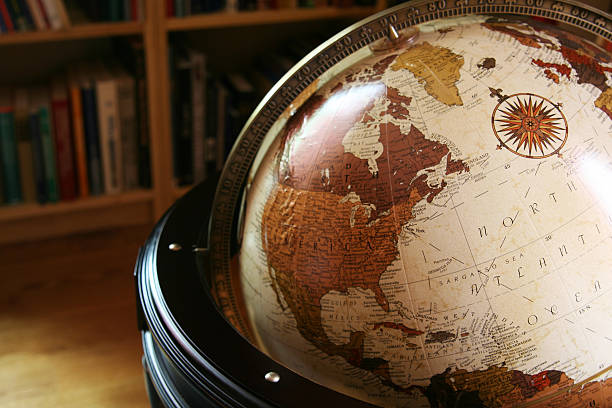
The Traditional Look (Library/Study): Seek out globes with deep, muted colors (sepia oceans, muted browns and greens for landmasses) and heavy, dark bases made of wood (walnut or mahogany) or antique brass. This style anchors a room with gravitas and scholarly weight.
-
The Mid-Century Look (Eclectic/Modern): Focus on the iconic globes produced from the 1950s-1970s. These often feature brighter cerulean blue oceans, streamlined plastic or chrome bases, and highly visible political borders. They inject a retro pop of color and clean line into a more muted or traditional space.
-
Size and Impact: A floor-standing globe (often 32 inches or more in height) is the ultimate statement piece, instantly commanding attention in a large living room or office. A tabletop globe is better suited for desks, side tables, or bookshelves, providing a smaller, intimate accent.
4. Budget Vintage Globe Display Ideas (Styling Hacks and Placement)
High-quality globes can be expensive. These hacks use strategic placement and grouping to maximize visual impact without a major investment.
-
The Grouping and Scale Hack: Resist displaying just one. Grouping three or five small, inexpensive globes of varying sizes, ages, and colors on a single mantelpiece, long shelf, or table creates a curated collection that appears intentional and expensive. The variety adds visual complexity.
-
The Pedestal Elevation Trick: If your globe is small or has a simple base, elevate it. Place it on a stack of large, leather-bound books, a simple wooden pedestal, or a thick glass cube. This adds vital height, visual importance, and emphasizes its artifact status.
-
The Lighting Focus: Position a tabletop globe directly under a small, warm-toned spot lamp, a picture light, or within the direct light cone of a desk lamp. The light will emphasize the spherical shape, highlight the names and borders, and turn it into an illuminated artifact, particularly effective in the evenings.

The Map – Framing, Placement, and Unique Wall Art Using Vintage Maps
Vintage maps are perfect for large-scale wall art, offering immense visual texture, historical density, and unique color palettes that traditional art often cannot provide. The framing strategy is the most critical element.
5. How to Decorate with Antique Maps (Framing Essentials)
The framing choice dictates whether the map is perceived as a valuable artifact or a cheap reproduction. The effort invested in framing directly correlates to the final aesthetic success.
H3: Framing for Historical Reverence and Longevity
-
Glass and Preservation: Always use conservation-grade, UV-protective glass or acrylic to prevent further fading of the aged paper and inks. The map should be mounted using acid-free materials (such as museum board) to prevent chemical damage.
-
The Frame Choice: Use heavy, dark wood frames (mahogany, black, or deep walnut) for a classic, traditional look. For an Industrial or Dark Academia feel, use thin, antiqued brass or matte black metal frames. The frame must be substantial enough to carry the weight of the map’s visual complexity.
-
Matting Strategy: Avoid bright white mats, which clash harshly with the sepia or aged-cream tone of the paper. Use sepia, cream, or charcoal gray mats to subtly complement the map’s vintage color palette. The matting provides necessary visual space, ensuring the map looks like an honored artifact.
6. Unique Wall Art Using Vintage Maps (Creative Display Hacks)
Vintage maps offer creative opportunities far beyond simple square framing.
-
The Pull-Down Chart Integration: If you acquire an original vintage school pull-down chart (often featuring large, high-contrast, beautiful colors), keep it on its original mechanism. Install it above a sofa, desk, or sideboard. The rolled-up texture and functional mechanism add an industrial-scholarly flair and offer flexible display.
-
The Grid Gallery Hack: This is an excellent budget hack. Purchase several small maps from a discarded vintage atlas (or reproduction prints) that share the same color tone. Cut them into equal sections (e.g., 8×10 or 12×12 squares) focusing on different continents or regions. Frame them identically in a minimalist black frame and hang them in a tight 3×3 or 4×4 grid. This creates massive, cohesive visual impact from small, affordable pieces.
-
Map as Wallpaper/Mural: For a transformative look, use high-quality, large-format reproduction map prints as a temporary, removable wallpaper for a small accent wall (e.g., in a powder room, a nook, or behind a home bar). This instantly turns the entire wall into a cohesive, immersive statement.
Sourcing, Collecting, and Budget Hacks
Knowing where to buy antique maps and globes is essential for balancing historical authenticity with a realistic budget.
7. Where to Buy Antique Maps and Globes (Sources and Tips)
-
Antique Shops and Flea Markets: Ideal for finding unique, unexpected pieces and the occasional genuine antique. Be prepared to inspect the condition closely and negotiate the price.
-
Online Print Sellers (Etsy, specialized sites): Excellent for high-quality, digital reproductions of specific historical maps (like Timbuktu, 17th-century celestial charts, or classic school maps). This is the best budget source for large-scale wall art.
-
Estate Sales and Vintage Fairs: Often the best source for finding mid-century globes and vintage atlases in good condition at affordable prices. Look for globes from brands like Replogle, Rand McNally, or Weber Costello.
-
Specialty Auction Houses and Cartography Dealers: Necessary if you are looking for highly valuable, true antique maps (pre-1900s) signed by known cartographers (e.g., Ortelius, Mercator). This requires expertise and a much larger budget.
8. Budget Hacks: Utilizing Atlases, Repurposing, and Digital Prints
Collecting doesn’t have to be prohibitively expensive if you are willing to embrace creative hacks.
-
The Atlas Disassembly Hack: Instead of buying a single, large, expensive map, purchase a vintage, discarded atlas (1940s-1970s). Carefully remove the large, intact pages and frame them individually. The resulting collection of unique, small prints is highly stylish and exceptionally affordable, perfect for a gallery wall.
-
Decoupaging Furniture: Use discarded or reproduction map pages to decoupage the top of a plain wooden side table, the back interior of a bookshelf, or the front panels of a small chest of drawers. Seal the paper with multiple coats of clear varnish or epoxy resin for a durable, custom, and scholarly piece.
-
Digital Prints for Large Scale: Purchase high-resolution digital files of antique maps (often available cheaply or for free from museum libraries). Print these files at a local print shop on heavy matte paper. This allows you to achieve massive scale (36×48 inches or larger) for a fraction of the cost of buying an original.
Advanced Styling and Maintenance
This section explores historical cartography in interior design by integrating it into specific room functions and providing long-term maintenance advice.
9. Historical Cartography in Interior Design (Room by Room Application)
-
The Living Room (Focal Point): Use a massive, dramatically framed map (50 inches or more) as the primary focal point over the sofa or fireplace. Complement this with a floor-standing globe positioned near a window or in a large corner.
-
The Office/Study (The Functional Element): The map or globe should be within arm’s reach. Use a small, detailed tabletop globe on the desk for quick reference. Hang smaller, highly detailed maps (e.g., city plans, nautical charts, or historical surveys) in a tight grid above the workspace.
-
The Kitchen/Dining Area: Use maps that relate to food or trade routes (e.g., spice routes, tea trade maps). Frame them simply and ensure they have a protective coating or glass to handle kitchen moisture.
-
The Nursery/Kids’ Room: Use a bright, mid-century vintage globe and large, colorful, yet historically accurate world maps. This serves as both stimulating decoration and an educational tool.
10. Layering, Grouping, and Maintenance Techniques
-
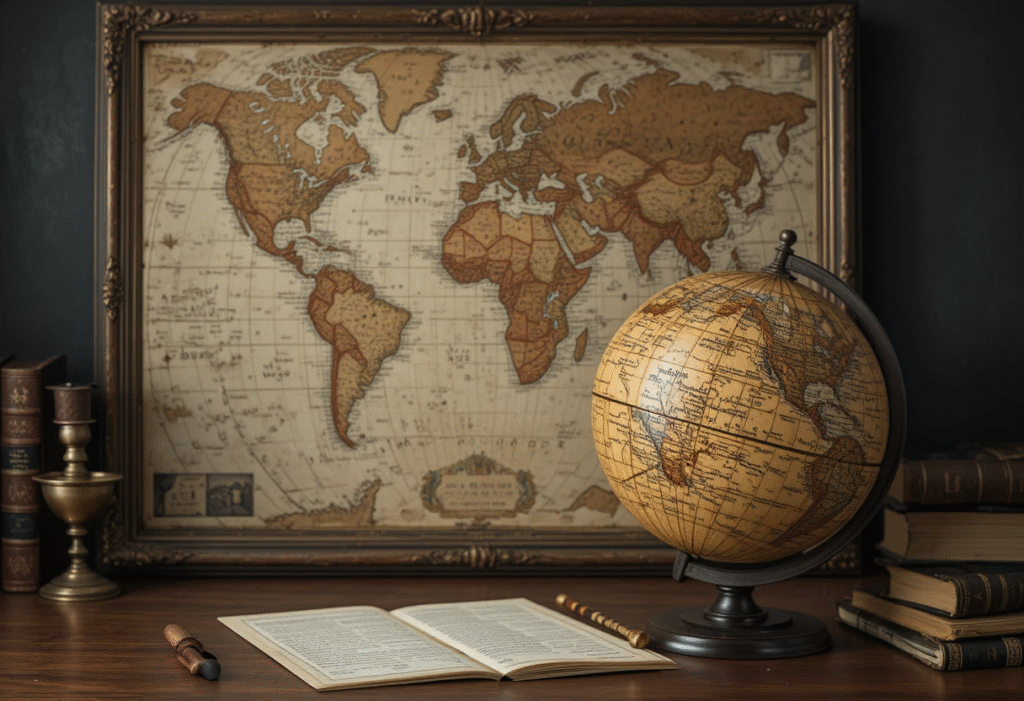
The Layered Shelf: On a bookshelf or mantelpiece, place a small tabletop globe next to a stack of books. Lean a small, framed map against the wall behind the globe, creating visual depth and dimension. Place a small, related artifact (e.g., a brass compass or magnifying glass) in front of the globe.
-
Mixing Media: Don’t display cartography alone. Hang a large map flanked by two smaller pieces of related art—such as a framed astronomical chart, a piece of pressed botanical art, or a black-and-white photograph of an ancient ruin—to enrich the scholarly theme.
-
Maintenance for Longevity: For original paper maps, never hang them in direct sunlight or above a heat source (like a fireplace or radiator). Temperature and UV fluctuations cause irreversible damage. Dust globes gently with a soft cloth and avoid chemical cleaners on the printed paper surface.
Conclusion: A Timeless Intellectual Haven
The choice of Vintage Globes and Maps Decor is a sophisticated embrace of history, intellectual curiosity, and aesthetic richness. It is a rebellion against the purely decorative, offering instead elements that are intrinsically tied to scientific effort, political narratives, and the human spirit of discovery.
By adhering to the principles outlined—meticulously selecting your artifacts based on historical context, utilizing strategic framing to elevate the piece, and employing unique wall art using vintage maps and budget vintage globe display ideas—you create more than just a beautifully decorated room.
You create a permanent intellectual haven—a space where the whispers of history and the vastness of the world mingle with your daily life. This is the ultimate environment for a life dedicated to learning and elegant living.